Batch status

Five years of experience. Or one year, five times?

You already know how to code. What's missing is depth: scale, trade-offs and design, the things service projects never gave you room to learn. Build it, get every decision reviewed, and walk into product-company interviews with proof.

resume.pdf · Experiencepage 1 of 2
Software Engineer · Backend2021 – present · 5 yrs
IT services · Client: a large US bank
  • Resolved 2,000+ tickets across 3 client projectsDesigned the orders schema and indexes for 1M users
  • Maintained legacy Java modules for the payments teamShipped API v2 without breaking a single client
  • Implemented change requests as per client specifications
  • Supported production releases and weekend on-call
Our learners work at
  • SAS
  • Cricbuzz
  • Simpplr
  • Circana
  • GeekyAnts
  • HireQuotient
Be honest

Sound familiar?

0 of 6

Try this · 30 seconds

Accept. Accept. Accept.

You're building a checkout endpoint and the AI is suggesting the code. Do what most of us do.

checkout.jsLines you wrote: 0Lines you accepted: 0
The shift

Code is cheap now.

What got you hired in 2020
  • Knowing the framework
  • Closing tickets on time
  • Years on the résumé
  • Writing the code
What gets you hired now
  • Knowing why it’s slow
  • Owning the decision
  • Systems you can defend
  • Reviewing the code AI writes
The interview

You've had this interview.

InterviewerYou have five years of backend. Walk me through a schema you designed.

You…

InterviewerOkay. This query is slow at ten million rows. Why?

You…

InterviewerWould you add a cache, or fix the index?

You

You'll answer every one of these in the program, with a reviewer pushing back.

A letter to developers with 2 to 8 years of experience

If you're just pressing Accept, Accept, Accept… you'll be phased out. Soon.

If you tried the checkout above, you just accepted eleven lines of code without reading any of them. At work it looks like this: it's 11 pm, the AI suggests a fix, you press Tab, the tests pass and the ticket closes.

You've done some version of this for years. So let me ask you something uncomfortable: if the AI wrote it and you approved it, what exactly did you do?

Five years ago, the industry paid people to write code. If you knew the framework and closed your tickets on time, you had a career. AI writes that code now, so it's getting cheaper every year.

I think tech is turning into acting or flying, where the people at the top are paid very well and everyone else waits for the next call. There isn't much of a comfortable middle left.

The work AI does best is well-specified work: tickets, change requests, CRUD, and migrations someone else designed. That's most of what service projects give you. It isn't your fault, but it is your problem.

The engineers who stay are the ones who can answer the questions AI can't own:

  • Why is this query slow, and what happens at 10× the data?
  • Which API change breaks a hundred clients?
  • Cache, or fix the index?

AI can suggest the answer, but you're the one who deals with what happens in production.

Now is the last window to put your head down and outwork everyone else. In a year, everyone will feel the effects of this shift. The people who start now will be the ones running the interviews.

With Vyson, outworking everyone looks like 8.5 focused hours a week, on top of your job, for 10 months. Your submissions will come back with red pen on them, and you'll redo them until they're right, because the redo is where most of the learning happens.

By the end, you'll have built a backend that scales to a million users, and you'll be able to explain every decision in it to an interviewer, because your reviewer already made you defend each one.

You can keep pressing Accept, or you can become the engineer who decides what gets accepted.
Swapnil Agarwal
Swapnil AgarwalFounder, Roc8 Careers. Placing developers since 2020.
Backend Dev · AmazonSDE-3 · MeeshoB.Tech CSE · IIT Guwahati '16
From people in your seat

You're not behind. You just haven't been given the problems.

With over 3 years of experience, I understand that companies now expect depth in whatever skills you have. Since my company is service-based, it is very difficult to gain that depth.

Asmit ShrivastavaSSE @ GeekyAnts
Learner story · Module 1, Assignment 1

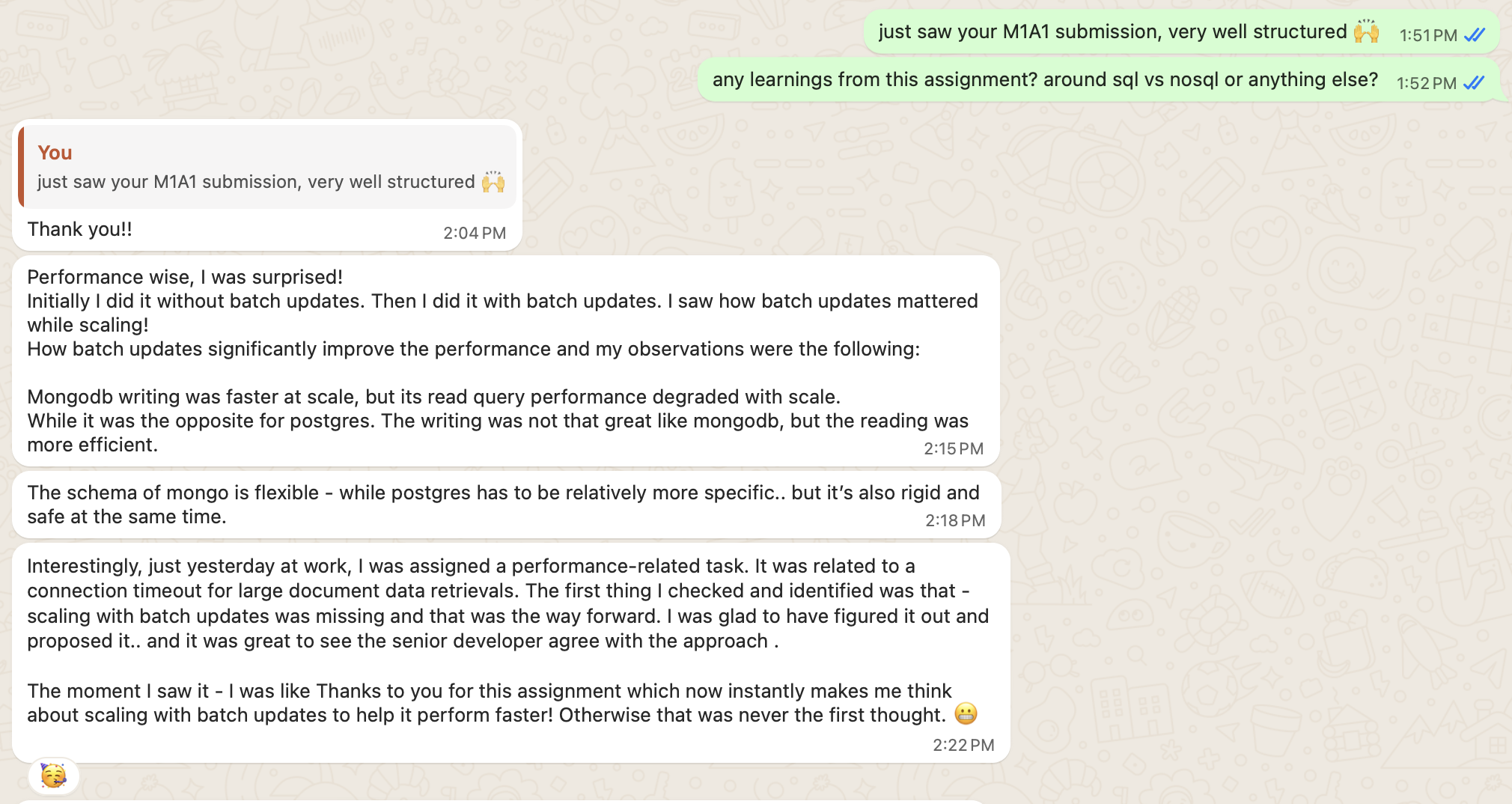
Did the batch-insert assignment. Fixed a production timeout at work the next day.

A learner benchmarked MongoDB against Postgres at scale, with and without batching. The next day at work they got a connection-timeout bug on large document reads. They spotted the missing batching first, proposed the fix, and their senior agreed.

WhatsApp conversation: a learner compares MongoDB and Postgres write and read performance, then the next day at work fixes a connection timeout using batch updates, and a senior developer agrees with the approach

I have learnt more in 1 week than last 1 month.

Saurabh G GhatnekarData & Analytics @ MeasureBit

This is the most fun I have had programming in a long time. I can see learning gaps from backend work at office getting filled. The tasks are very demanding even with help from AI and Google.

Rajat GuptaFullstack @ Simpplr

I was stuck reading and watching tutorials for a very long time. Vyson is building my confidence with hands-on assignments.

Abhijit PurohitSr. TSE @ SAS India

So many other questions pop into my head while solving each assignment. This is making sure I find answers to them.

Nitish VarmaSoftware Engineer @ Cricbuzz

A totally different approach from building projects by following YouTube videos. It develops critical thinking.

Prashant KaushalBackend Developer @ Circana
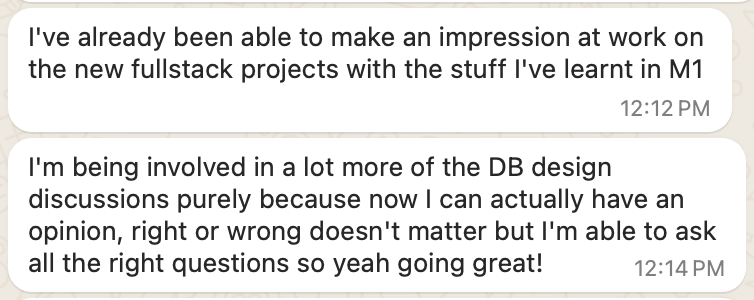
Unedited, straight from WhatsApp
Learner says after Module 1 they made an impression on new fullstack projects at work and now contribute to database design discussions by asking the right questionsLearner says they have come far in 1.5 months, learning how indexes work underneath and how the query planner changes plans as data growsLearner enjoyed inserting 100 million rows for the first time and seeing how PostgreSQL and MongoDB differ in speed and storageLearner reports a query going from 6 seconds to 0.6 seconds after adding an index
Read this before you join

Who this is not for.

  • Beginners. You need professional experience as a developer. Any kind counts: frontend, mobile or backend.
  • Certificate collectors. If you mainly want a certificate for LinkedIn, this isn’t built for that.
  • Video bingers. There are no lectures to watch at 2× speed. You build, then you get reviewed.
  • Anyone who won’t redo a submission. Some submissions come back three times, and each round of review is where you learn the most.
  • Anyone looking for a shortcut. It’s 365 hours of work, and we’d rather you know that before you join.
What it takes

Your evenings, for 10 months.

About 8.5 hours a week alongside your job. That's 365 hours of building.

You'll be tired. Reviews will send you back. That's the point.

₹5,900/ month for 10 months · ₹59,000 in total
₹

Enter it to see what one month costs you.

Join the waitlist →

Do the first week. If it isn't the hardest, most useful week of your year, ask for a full refund within 7 days.

Already strong in databases? There's a 5-month fast track →
FAQ

What's stopping you?

I'm exhausted after work. Can I really do this?

Some weeks will be hard. That's why the standard track is 10 months at about 8.5 hours a week: an hour on weekday evenings and a few on the weekend. It's self-paced, so a bad week at work doesn't sink you, and doubt sessions get you unstuck so you don't waste the hours you do have.

Am I too late with 8 years of experience?

No. Your years help: you already know how production works from the inside. What's usually missing is ownership of the hard decisions (schema, contracts, architecture), and that's what every assignment makes you practise.

My project uses old tech. Does that matter?

No. We're language-agnostic: use Java, Python, Go, Node.js or whatever you work in. Indexes, API contracts, queues and scaling work the same way on any stack.

Will this help me switch to a product company?

That's what it's built for. The scenarios come from what recruiters ask us for, the last module is interview prep with timed assessments and mock interviews, and you finish with a backend you built and can defend line by line. We can't promise you an offer, but you won't walk in with nothing to show.

Next cohort · 15 Nov 2026

15 Nov 2026

Seats are limited because every review is done by a human.

Two years from now
Path A

Same project. Same client. More AI, and fewer reasons to keep you.

Path B

You’ve built a backend for a million users and can defend every trade-off in it, so an interview becomes a conversation about your own work.

Become the engineer who decides what gets accepted.
Or message us on WhatsApp with the code VYSON.


